
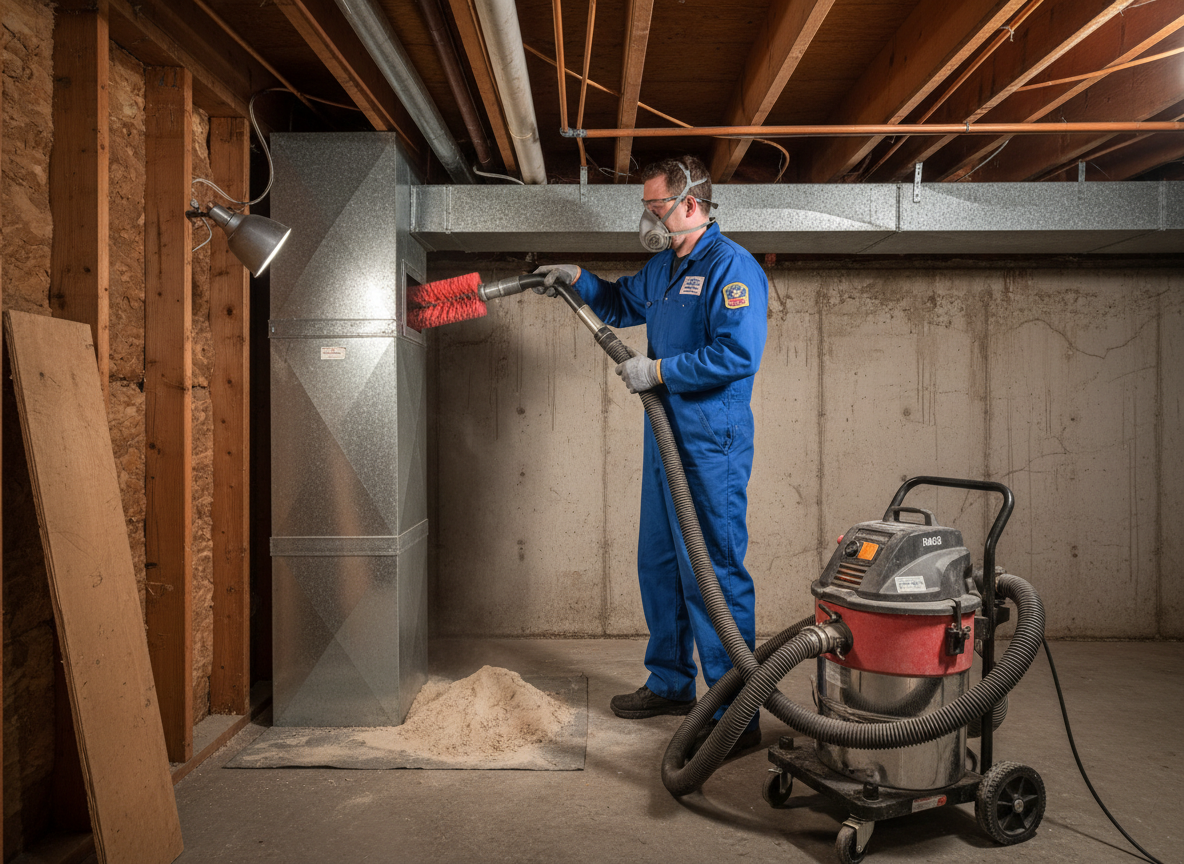
Milwaukie sits in Clackamas County with many homes built before 1970 that still run original sheet-metal ducts. Wet winters bring constant humidity that condenses inside those runs, feeding mold on the metal seams and fiberglass liners common in 1960s and 1970s construction. Professional air duct cleaning here means pulling the registers, using negative-air machines with HEPA filtration, and brushing every accessible trunk and branch line to break the biofilm that standard vacuuming misses.
Pollen from Douglas fir and bigleaf maple blows in through open windows during spring and fall, then settles in the return plenums near the furnace. In neighborhoods like Ardenwald and Hector Campbell, low crawl spaces keep ducts close to moist soil, so technicians often find standing water and rusted joints that must be dried and sealed after cleaning. Skipping the return side or failing to clean the blower housing simply moves the same contaminants back into living spaces once the system restarts.
Handling Oregon Moisture During Cleaning
After brushing, every accessible duct receives a low-moisture antimicrobial treatment approved for HVAC use. Technicians then run the system on high for thirty minutes with the home windows open to purge remaining particles before reinstalling registers. This step prevents the musty smell that appears when damp residue is left behind in Clackamas County homes.
What Changes the Job in Older Milwaukie Stock
Homes near SE Main Street often have flex duct additions from past renovations that sag and trap debris. These sections require extra time to support and clean without tearing the outer jacket. Technicians also check the connection at the air handler for gaps that let unfiltered attic air enter, a common leak point in single-story ranches built on slabs in the 1950s.
Technician insight
In Oregon the thing that catches most people out with professional air duct cleaning is how the constant winter moisture turns ordinary dust into a sticky layer that only mechanical agitation removes; skipping the returns or the blower housing in Milwaukie homes built on slabs near SE Main Street just recirculates the problem the next time the furnace kicks on.
Ardenwald Home with Persistent Musty Odor
Homeowners noticed a damp smell whenever heat ran. Inspection found standing water in a low crawl-space trunk line and heavy biofilm on the original 1968 sheet-metal ducts. After negative-air brushing, drying, and sealing the rusted joints, the odor disappeared and airflow improved noticeably through every register.
How it works
- 1
Site Assessment
Technician inspects every accessible duct run, registers, and the furnace or air handler to map the system and note moisture or damage.
- 2
Negative-Air Setup
Equipment creates containment and pulls debris through HEPA filtration while protecting living spaces from redistributed particles.
- 3
Mechanical Brushing
Rotating brushes and air whips dislodge buildup from trunk lines, branches, and returns without damaging metal or liner.
- 4
Post-Clean Verification
System is run and inspected to confirm airflow improvement and that no loose debris remains before registers are reinstalled.
Pricing
Pricing depends on number of runs, access difficulty in crawl spaces or attics, and whether flex duct or liner replacement is required.